
Let’s discuss ‘Standby Letter of Credit vs Bank Guarantee,’ which is a common confusion in the minds of many. A standby letter of credit and a bank guarantee are actually very similar products. As a matter of fact, if we go back and look at the origination of the standby letter of credit, we may be able to understand the similarity better. At SVF GP Ltd, we’ve seen clients mix them up many times, so let’s break it down in simple terms.
Under the Glass-Steagall Act, passed by the US Congress in 1933, banks were not allowed to participate in investment banking activities. Consequently, they couldn’t issue a bank guarantee as well. As this was a lucrative business, they got around this act by forming their letters of credit as bank guarantees. They called this new product the standby letter of credit. From this, we can infer that the standby letter of credit is actually a hybrid version of a bank guarantee.
Definitions of SBLC and Bank Guarantee
An SBLC is a financial instrument issued by a bank that serves as a guarantee of payment to the beneficiary in the event that the applicant fails to fulfill their obligations under the underlying contract.
Example:
Let’s say a client from Dubai wants to buy crude oil through SVF GP Ltd, but the supplier in Europe doesn’t know the buyer well. To build trust, the buyer’s bank issues an SBLC in favor of SVF GP Ltd. This tells the supplier, “Don’t worry — if the buyer fails to pay after shipment, SVF GP Ltd will get paid through the SBLC.”
That way, the deal moves forward smoothly.
A Bank Guarantee is a written undertaking by a bank to make payment to the beneficiary in the event that the applicant fails to fulfill their obligations under the underlying contract.
Example:
Suppose SVF GP Ltd partners with a construction company in the UK. The contractor must build a fuel storage facility within 6 months. To show commitment, the contractor gives SVF GP Ltd a Performance Bank Guarantee (BG).
If the contractor fails to finish the job, the bank will pay compensation to SVF GP Ltd as agreed in the BG terms.
Types of Bank Guarantee and SBLC
There are different types of SBLC and BG, including:
- Performance SBLC and BG: These are used to guarantee payment for the performance of the applicant’s obligations under the underlying contract.
- Financial SBLC and BG: These are used to guarantee payment for the applicant’s financial obligations under the underlying contract, such as the payment of rent, taxes, or interest.
- Advance Payment SBLC and BG: These are used to guarantee payment of an advance payment made by the beneficiary to the applicant for the fulfillment of the underlying contract.
Uses of SBLC and Bank Guarantee
SBLC and BG are used for similar purposes, including:
- Assuring Payment: Both instruments provide assurance to the beneficiary that they will receive payment in the event that the applicant fails to fulfill their obligations under the underlying contract.
- Facilitating Trade: SBLC and BG facilitate international trade transactions by providing security and reducing the risk of non-payment.
Difference Between Standby Letter of Credit (SBLC) and Bank Guarantee (BG)
The Difference in Nature
A standby letter of credit is a secondary payment method where the bank promises the payment if the seller fulfills the terms of the letter of credit. This means if the buyer fails to pay, then as long as the seller meet’s the requirement of the standby letter of credit, the bank will pay.
Even though a bank guarantee is similar to a standby letter of credit in a way that it is a promise of payment from the bank, it is based on a contingent obligation. This means one can take shelter from a bank guarantee in case of occurrence of a certain contingent event, such as – a project never takes off or a construction project is halted in the middle stage.
Difference in Practice
From a practical perspective, the standby letter of credit is quite different from a bank guarantee. While a bank guarantee is only concerned with financial performance (e.g., sale of goods, construction, etc.), the standby letter of credit is extremely diverse. It covers a host of financial and non-financial performance factors. A standby letter of credit most definitely covers regular financial risk factors such as timely payment of goods. Still, it may also cover non-financial risk factors such as a particular material requirement, defect margin, etc. Thus, we can say that the standby letter of credit is a more holistic instrument compared to a bank guarantee.
Click here to read more on Bank Guarantee providers….
SBLC VS Bank Guarantee: The Key Difference
| Feature | SBLC | BG |
| Main Use | Payment backup | Performance or obligation backup |
| When Triggered | If buyer fails to pay | If contractor or client fails to perform |
| Nature | Financial guarantee | Performance guarantee |
| Common Users | Importers, exporters | Project owners, contractors |
Why the Distinction Matters
A European shipyard will often stipulate a BG in URDG 758 language—if the buyer submits an SBLC instead, the yard’s bank may reject the instrument on day one. Conversely, a US counterparty may insist on an SBLC because its treasury back-office is equipped to process LC formats. Understanding the underlying rule-set avoids last-minute amendments, re-issuance fees and strained relationships.
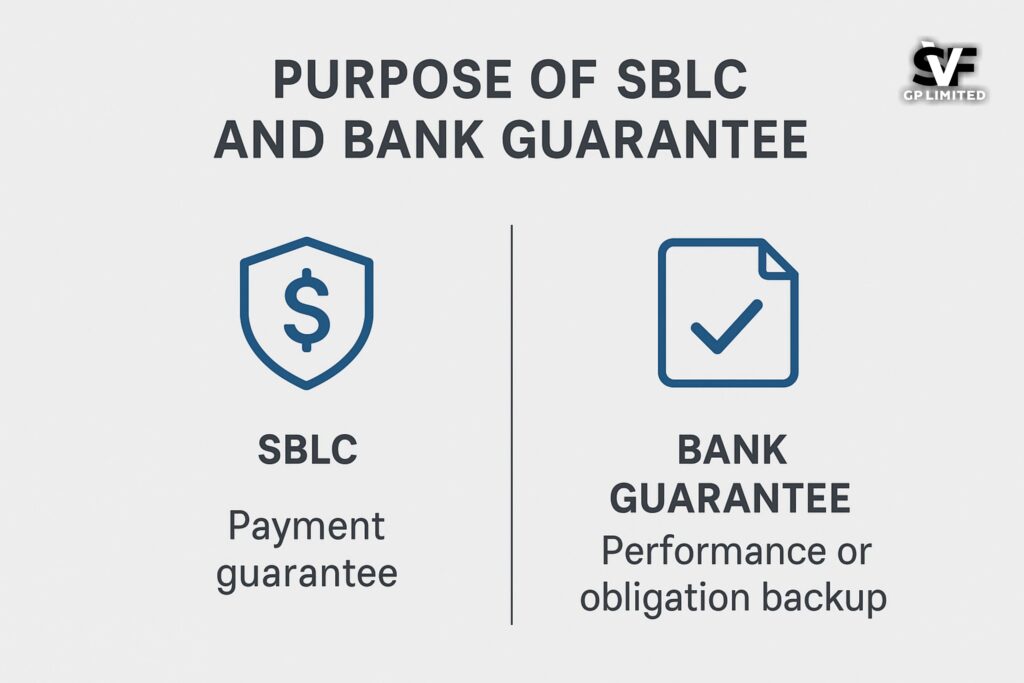
Purpose of SBLC & Bank Guarantee
The main purpose of the standby letter of credit is to provide a fair business opportunity and to facilitate boundaryless business transactions.
This also enhances the credibility of international trade and also motivates new customers to enter into international trade.
With the help of these instruments, the business entities in the world can take maximum benefit by importing the scarce resources and exporting the abundant resources of the country.
This type of instrument is created upon the strict regulations placed by the US regulatory authorities on the banks.
However, the purpose of the bank guarantee is to make a promise from a lending institution that ensures a bank will step if the debtor cannot recover the debt. These instruments assure the safeguard of the rights of both parties to the contract.
These instruments also act as a source of increasing the competition among the different economies around the globe. Due to increased in such competition the dealing of the goods is undertaken at quite a fair price.
When to Use an SBLC
SBLCs are ideal for situations where payment is a priority. For instance, in international trade, an SBLC ensures that the seller is compensated if the buyer fails to fulfill payment obligations. They are also used in performance guarantees, such as ensuring that a contractor completes a project on time.
When to Use a Bank Guarantee
A Bank Guarantee is more suited for a large – scale infrastructure projects or service contracts where the scope of obligation. For example, a contractor working on a government project may need a Bank Guarantee to assure the government that they will complete the project or compensate for any losses if they fail.
How SBLC Works
Here’s how it works step by step:
- Agreement Between Buyer and Seller
John, a trader in UK, agrees to supply crude oil to Mike, a buyer in Germany. Because it’s their first deal, Mike’s supplier wants a guarantee of payment before shipping. - Buyer Requests an SBLC
Mike goes to his bank and applies for a Standby Letter of Credit in favor of John. The bank checks Mike’s credit and financial strength before issuing the SBLC. - Issuance and Transmission
Mike’s bank (called the issuing bank) sends the SBLC through SWIFT to John’s bank (the advising bank). This officially confirms that payment is guaranteed if Mike fails to pay. - Goods Shipment or Service Delivery
Once John receives confirmation, he ships the crude oil or delivers the goods as agreed in the contract. - Payment Period
Mike is expected to pay directly once documents like the Bill of Lading are confirmed. If he pays, the SBLC simply expires unused. - If the Buyer Fails to Pay
Suppose Mike runs into financial trouble and cannot pay. John can present the required documents to his bank, which will then forward them to Mike’s bank to draw on the SBLC. - Settlement
Mike’s bank pays John the amount stated in the SBLC, and later collects the money from Mike.
In this way, the SBLC acts like a safety net. It allows international traders to do business confidently even without long-term relationships or local legal protection.
How Bank Guarantee Works
Here’s how it works step by step:
- Contract Agreement
John runs a construction company. Mike hires him to build a fuel storage tank within six months. To prove commitment and seriousness, John provides a Performance Bank Guarantee through his bank. - Issuance of the Guarantee
John’s bank issues the BG in Mike’s favor and confirms that if John fails to complete the project, the bank will pay compensation up to the guaranteed amount. - Work Period
John begins the project. During construction, the BG serves as security for Mike, giving him confidence that his money is safe even if John defaults. - If the Contractor Performs Well
When John completes the project on time and meets all conditions, the BG expires automatically. It’s never used. - If the Contractor Fails
If John doesn’t finish the project or walks away from the contract, Mike can claim the Bank Guarantee. Mike submits evidence of non-performance to the bank, and the bank pays him as agreed.
Conclusion
In conclusion, SBLC and BG are two distinct financial instruments that serve similar purposes in international trade transactions. Understanding the differences between them, including their definitions, types, and uses, is crucial in choosing the appropriate instrument for a particular transaction. While both instruments provide security and reduce the risk of non-payment, they differ in the nature of the guarantee, parties involved, and payment.
Let’s Help You Secure Your Next Global Trade Deal
At SVF GP Ltd, we understand that every business deal carries risk — whether it’s payment, performance, or trust. That’s why we provide structured financial solutions designed to protect your transactions and support your international goals.
Whether you’re looking to use an SBLC, Bank Guarantee, or other trade instruments, our team will guide you step by step — from document preparation to successful completion. We’ve helped businesses across sectors build confidence with their partners and expand beyond borders safely.
If you’re planning your next import, export, or infrastructure project, now is the time to work with experts who understand real trade finance.
Reach out to us today at StructuredFinance@svfgpltd.com or visit www.svfgpltd.com to start your journey toward safer, smarter, and more profitable transactions.
SVF GP Ltd — Securing Trust, Financing Growth, and Powering Global Trade.
FAQ
- Can a BG be converted into an SBLC?
Only by cancelling and re-issuing; the rule-sets are not interchangeable.
- Who pays issuance fees?
Normally the applicant; Financely negotiates competitive pricing with issuers.
- Are transfers allowed?
SBLCs may be transferable if flagged at issuance; BGs rarely permit onward transfer.
- What currencies are available?
USD, EUR, GBP and major trade currencies—subject to issuer limits.
- How is an SBLC different from a regular Letter of Credit (LC)?
SBLC: Acts as a guarantee, triggered only in case of non-performance or default.
LC: Facilitates payment by ensuring that funds are transferred once the terms of the trade are fulfilled.